According to official statistics released on October 1, 2026, by the Architectural and Housing Division of the Toyama Prefectural Government, new housing starts from April to August 2026 increased significantly compared to the same period in 2025. However, detailed examination shows that disparities between regions and between property types are widening. The three main points to understand this situation are as follows.
- Cumulative housing starts in Toyama Prefecture reached 1,968 units from April to August 2026, an increase of 33.9 percent year-on-year, but August alone recorded 389 units, a drop of 10.4 percent from July.
- Construction concentrated heavily in the three main cities of Toyama, Takaoka, and Imizu, which together represented 77.5 percent of all housing starts in the prefecture.
- Owner-occupied houses rose by 40.9 percent and rental houses grew by 28.2 percent, but built-for-sale houses grew by only 13.9 percent and dropped to 25 units in August, the lowest monthly level this fiscal year.
Contents
Recovery in Construction Volume and the Recent Slowdown Across Toyama Prefecture
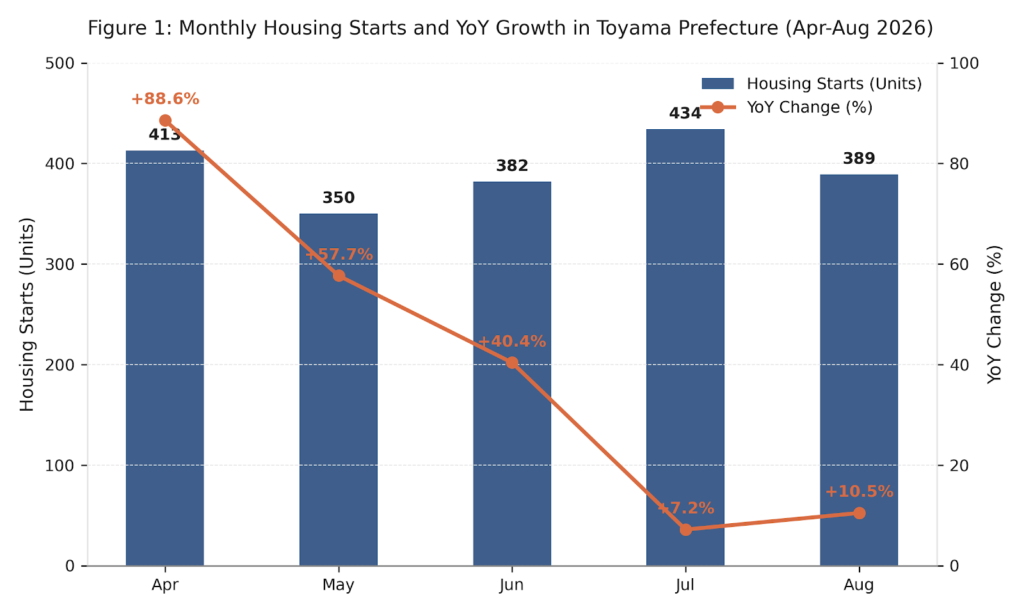
During the first five months of fiscal year 2026, housing construction in Toyama Prefecture grew rapidly. Year-on-year growth was 88.6 percent in April, 57.7 percent in May, and 40.4 percent in June, continuing at high levels well above 2025 results. Cumulative housing starts between April and August reached 1,968 units, an increase of 33.9 percent from 1,470 units during the same period in 2025.
However, the trend changed in August. Total housing starts in August were 389 units. While this remained 10.5 percent higher than in August 2025, it was 45 units lower than the 434 units recorded in July. Total floor area also decreased by 17.2 percent, dropping from 38,152 square meters in July to 31,575 square meters in August. The rapid pace of construction seen in spring has slowed down, and the monthly trend is moving into an adjustment phase.
Comparison with Non-Metropolitan Prefectures and National Averages
According to housing construction statistics compiled by the Ministry of Land, Infrastructure, Transport and Tourism, housing starts across Japan have stayed sluggish, especially in owner-occupied housing, due to high building material costs and rising mortgage interest rates. In regional areas outside the three major metropolitan areas, declining populations and elevated construction costs have caused new construction numbers to fall below previous year levels in many prefectures.
Compared to this general decline across regional Japan, the 33.9 percent cumulative increase in Toyama Prefecture is exceptionally high. In Toyama, plans to rebuild and relocate that were postponed after the 2024 Noto Peninsula Earthquake were finally executed once basic infrastructure was repaired. Unlike parts of Ishikawa Prefecture where severe destruction requires long periods for demolition and land readjustment, Toyama Prefecture saw rebuilding take place relatively smoothly on existing residential land, leading to an early buildup in construction numbers.
However, this increase did not come from permanent population inflow or organic economic growth. It reflects delayed demand from past disruptions.
Differences in Demand Across Housing Types
Looking at construction numbers by usage category reveals clear differences between segments that are growing and those where businesses remain cautious.
Owner-occupied housing showed the largest increase. From April to August, 1,081 units were started, an increase of 40.9 percent from 767 units in the same period of 2025. Total floor space for owner-occupied houses also grew by 42.0 percent to 123,591 square meters, showing that private home construction was the primary growth driver.
Rental housing also remained firm, reaching 695 units, up 28.2 percent year-on-year. Construction of apartment buildings grew particularly fast, reaching 446 units, an increase of 51.7 percent from 294 units in the previous year.
In contrast, built-for-sale housing showed weak momentum. Cumulative starts were 172 units, an increase of only 13.9 percent compared to 2025. In August alone, built-for-sale housing dropped to 25 units, down sharply from 38 units in July. With building costs staying high and buyers becoming cautious due to future mortgage interest rate increases, developers are limiting new construction starts to prevent unsold inventory from accumulating.
Concentration of Demand in Urban Areas and Stagnation in Outlying Regions
Regional data shows that almost all construction activity is concentrated in specific urban centers.
Toyama City recorded 1,053 housing starts from April to August, accounting for 53.5 percent of the prefecture total. In August alone, 195 units were started. In Toyama City, not only owner-occupied homes (81 units in August) but also rental units in row houses and apartment complexes (96 units in August) continued to be built to capture urban rental demand.
Takaoka City recorded 260 cumulative units, representing a 13.2 percent share, while Imizu City recorded 212 units, representing 10.8 percent. Together, these three cities totaled 1,525 units, or 77.5 percent of all housing starts in the prefecture. Housing demand is concentrated along main railway and road transport routes where public services and urban convenience are maintained.
In contrast, construction activity has declined sharply in other regions. In local cities such as Himi City (57 cumulative units), Uozu City (50 units), and Kurobe City (46 units), monthly construction stayed around several to a dozen units. In August, Uozu City dropped to 6 units, and Himi City and Kurobe City dropped to 4 units each. Nanto City recorded 29 units in August, but this temporary jump consisted of 5 owner-occupied single-family houses and 24 rental apartment units built in wooden structures, with zero built-for-sale homes.
In rural districts, market stagnation is severe. In Kamiichi Town, August starts were 2 units, bringing the cumulative total to 20 units. In Tateyama Town, August starts were 2 units, bringing the cumulative total to 35 units. In Shimoniikawa District, Nyuzen Town (10 units) and Asahi Town (4 units) together totaled only 14 units across five months. In Funahashi Village, zero housing starts were recorded between April and August, meaning new home construction stopped completely.
In these rural areas, commercial housing developments cannot be planned profitably, and construction has become limited to sporadic rental projects and private individuals rebuilding their own homes.
Toyama Housing Starts in May 2026: Stable Owned Homes and Shifting Investment Money