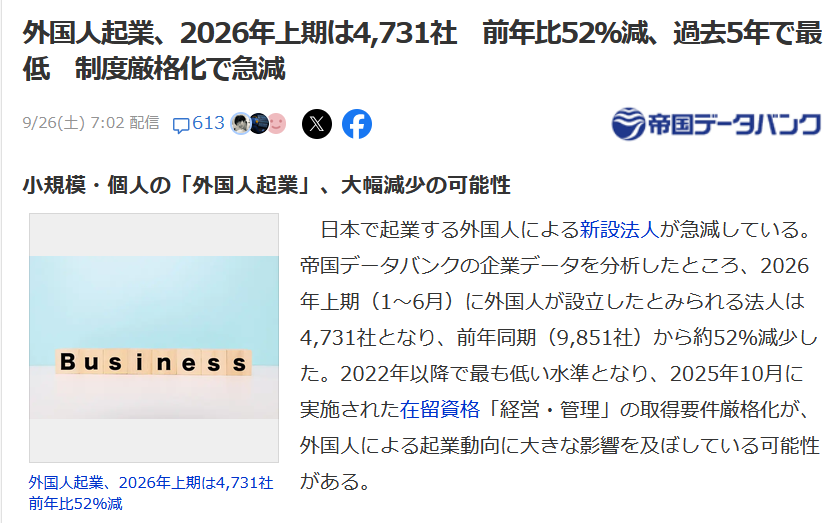
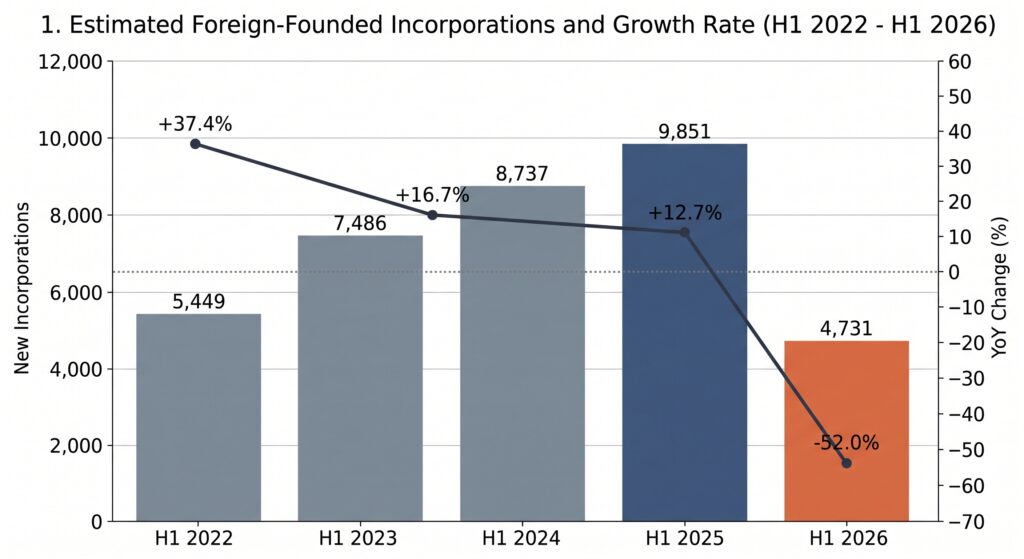
An analysis published by Teikoku Databank based on new company registration data as of August 2026 (estimated through name pattern analysis) shows that the number of new corporations likely founded by foreigners between January and June 2026 was 4,731. This marks a 52.0% decrease from 9,851 companies in the first half of 2025.
Key Points for Understanding This Article
- Following stricter immigration screening for the Business Manager visa in October 2025, company establishments lacking real operations dropped, cutting total formations by half compared to the previous year.
- Demand for virtual offices and small rental units used mainly for nominal address registration declined, shifting demand toward dedicated spaces and physical business properties.
- Handling legal procedures like the Foreign Exchange Act and Important Land Survey Act, alongside covering renovation costs for building use conversions, has become a core requirement for real business feasibility.
Contents
Shift in Policy Enforcement and the Drop in New Incorporations
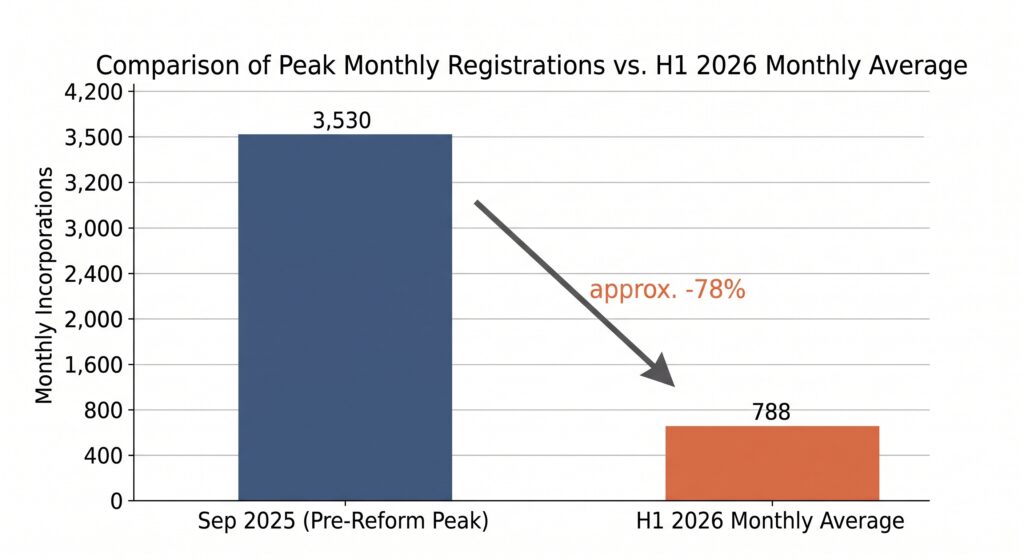
Looking at the estimated numbers, new companies founded by foreigners had grown steadily from 5,449 in the first half of 2022 to 7,486 in the first half of 2023, 8,737 in the first half of 2024, and 9,851 in the first half of 2025. In September 2025, just before the rule change took effect, registrations jumped to 3,530 in a single month, roughly 2.6 times higher than September 2024.
However, registrations dropped quickly after immigration revised the requirements for the Business Manager status in October 2025. In 2026, year-on-year monthly numbers remained low, dropping 43.9% in January, about 60% in May, and 55.0% in June. Stricter checks on paid-in capital sources and actual business activity were set up to curb paper companies formed simply to get or maintain resident status. Consequently, small-scale and solo ventures that relied purely on superficial paperwork fell sharply.
Restructuring Demand in the Commercial Rental Market
This sharp drop in new company formations is changing the rental market structure. Low-cost rental offices, virtual offices, and residential studio apartments used mainly for nominal corporate registrations are losing their primary tenant base.
Under the new review process, immigration checks whether businesses have separate workspaces, physical stores, or production facilities. As a result, non-partitioned hot desks and multiple companies registered at the exact same address now face heavy scrutiny. While occupancy rates for spaces relying on nominal registration have dropped, demand remains steady for private, partitioned spaces and real estate that can support day-to-day operations.
Regulations and Renovation Costs for Physical Property Acquisitions
Acquiring land and buildings to run physical businesses such as hotels, restaurants, or experience-based leisure facilities requires compliance with Japanese real estate and zoning rules, which heavily influences project schedules and budgets. Under the Foreign Exchange and Foreign Trade Act, non-resident investors buying business-use properties must submit a post-acquisition report to the Minister of Finance via the Bank of Japan within 20 days. In addition, acquiring properties in designated zones under the Important Land Survey Act (near defense sites and border islands), as well as lands governed by the Forest Act or National Land Use Planning Act, triggers mandatory filings either before or after the purchase.
When converting an existing building to another use, the conversion procedure under the Building Standards Act becomes a major cost driver. Converting more than 200 square meters of floor space into specialized facilities like hotels or commercial shops requires a formal building confirmation application. This step regularly obligates buyers to install evacuation stairs, fire-rated partitions, and sprinkler systems. On top of that, local government bylaws under the Inns and Hotels Act and the Private Lodging Business Act often restrict operating days, zoning, and minimum distances from schools, making upfront regulatory checks critical to project success.
Market Selection Driven by Capital and Execution Capability
The disappearance of paper companies has cooled off bidding competition for addresses and nominal leases. For operators who hold sufficient equity and can budget for licensing hurdles and architectural renovations, the market now offers a clearer path to evaluate and acquire physical properties.
Ventures with limited capital that cannot absorb regulatory filings and building upgrade costs are forced out. In contrast, opportunities are concentrating around investors who can adapt to local legal rules and invest in real physical assets. The policy change of late 2025 highlights the baseline requirements for running a location-dependent business in Japan, separating sustainable operations from paper-based setups.
Why Japan Is Offering Cheap Loans to Turn Vacant Houses into Rentals Nikkei, jiji