In the Japanese housing market, rising purchase costs and higher interest rates are changing how existing housing stock is used. On September 8, 2026, Jiji Press reported that the Ministry of Land, Infrastructure, Transport and Tourism included funds in its FY2027 budget request to launch a low-interest loan program for operators renovating vacant homes for rental use. The Nihon Keizai Shimbun (NIkkei) also reported on September 20, 2026, details about how this framework is being built.
Key Points
- MLIT requested 2.1 billion yen in capital for the Japan Housing Finance Agency in the FY2027 budget request to start low-interest loans for operators renovating vacant or aged public housing for rent.
- Rising prices for new apartments and higher mortgage rates make home buying harder, while legal depreciation rules for wooden homes keep private bank loans out of older properties.
- Public funding supplies financing to the market, but long-term profitability depends on aligning with municipal city plans and keeping daily property management costs low.
Rising New Build Costs and Supply Cuts Keep Tenants in Rental Units
Buying a newly built home has become much more difficult in urban areas. According to the Real Estate Economic Institute, the average price of a new condominium across Tokyo’s 23 wards reached 142.49 million yen for the January to June period, up 9 percent from the same period of the previous year. This is the highest level since tracking began in 1973. Combined with rising mortgage rates, this high price forces part of the homebuyer group to stay in rental apartments or look into older properties.
Meanwhile, home builders are cutting back on cheaper homes for families and lower-income earners. Daiwa House Industry raised the starting price of its custom homes to 50 million yen and pulled out of business in 23 prefectures because of rising costs. As developers build fewer low-cost homes, demand shifts further toward existing rental units and older properties.
The 22-Year Depreciation Barrier and Public Money Intervention
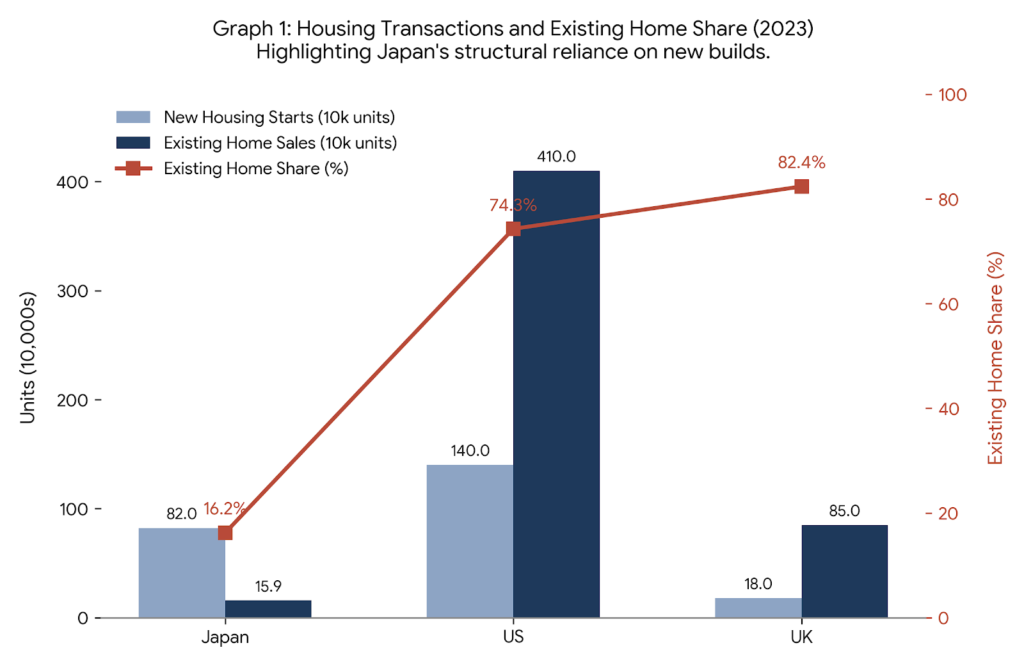
Looking at overall housing transactions, Japan’s existing home circulation remains far below other major economies. According to MLIT housing data for 2023, new housing starts were 820,000 units against 159,000 existing home sales, meaning existing homes accounted for only 16.2 percent of total market activity. This stands in sharp contrast to 74.3 percent in the United States and 82.4 percent in the United Kingdom.
This situation comes from local banking collateral standards. Wooden residential structures have a statutory useful life of 22 years under tax rules, and market practices usually write down building value to near zero after 20 to 25 years. Because vacant houses have minimal collateral value, operators have struggled to borrow renovation and acquisition money from commercial banks. As a result, while some large companies expanded nationwide by buying, renovating, and quickly reselling homes, holding properties for ongoing rental use has stayed limited to small operators.
The 2.1 billion yen capital injection for the Japan Housing Finance Agency in the FY2027 budget request uses public money to bridge this collateral gap. Using investment returns from government funds, the agency will provide low-interest renovation financing. The agency plans to finalize loan rates and criteria by the end of 2026, aiming to start lending in FY2027. This program covers both private vacant houses and the conversion of aged public housing into rental units.
Policy Requirements and Operating Costs Determine Business Outcomes
Access to low-interest public loans lowers the financial barrier to turning vacant houses into income-producing rental units. In the private market, companies like Ject One with its Akisapo service already lease vacant properties from owners, renovate them at company expense, and return them after the lease term ends. However, low-interest public money will not make every property profitable.
The new program requires close coordination with local governments. The government plans to link financing with municipal vacant house banks and prioritize loans for operators offering housing for families in line with local urban plans. In addition, local tax policies are changing; for example, Neyagawa City in Osaka plans to introduce a citywide vacant house tax in FY2029, raising holding costs on neglected properties.
Rental businesses targeting lower-income tenants and families have lower upfront acquisition costs, but face limits on maximum rents and higher ongoing management requirements. Securing cheap financing does not automatically guarantee steady long-term operating yields. A clear divide will form between operators who can acquire policy-aligned properties and keep renovation and management costs low, and those who borrow the funds but struggle with maintenance burdens and vacancy losses.
Hidden “Selection” Behind Nominal Growth: Structural Changes in Japan’s Real Estate Market