Contents
Summery
- Total new housing starts in Toyama Prefecture dropped by over 30 percent from the previous year. Development of non-wooden buildings and apartment buildings fell heavily.
- Toyama City accounted for more than half of the rented and built-for-sale housing supply in the prefecture. Localized concentration in one city is advancing.
- In Takaoka City and Tonami City, rented housing supply continues through row houses. However, in places like Uozu City, apartment development stopped.
According to the new housing starts statistics for fiscal year Reiwa 7 released by the Toyama Prefecture Civil Engineering Department Housing Division on May 11, Reiwa 8, big changes are happening in the housing development trend in the prefecture.
Overall Situation and Changes in Building Structures
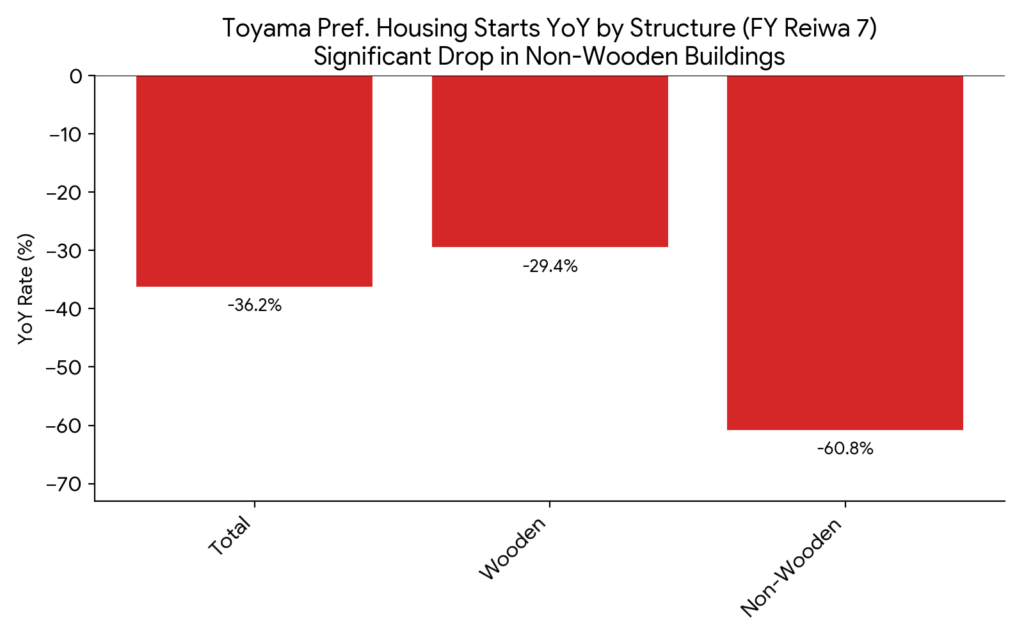
This shows the total new housing starts and the year-on-year percentage by structure. It visualizes that non-wooden buildings dropped much more than wooden buildings.
The total number of new housing starts in Toyama Prefecture was 3,783 units. This is a 36.2 percent decrease from 5,927 units in the previous year. By use type, owned houses dropped by 24.6 percent to 2,039 units. Rented houses recorded a bigger drop of 39.2 percent to 1,305 units. Built-for-sale houses dropped by 58.9 percent to 425 units.
Looking at the building structure, wooden housing starts decreased by 29.4 percent. Non-wooden housing starts fell sharply by 60.8 percent. By building type, detached houses decreased by 23.6 percent, while apartment buildings decreased by 54.4 percent. High construction costs made large apartment developments using steel frame or reinforced concrete unprofitable. Developers decided to skip new construction, and the numbers show this result.
Development Concentration in Toyama City and Supply Bias
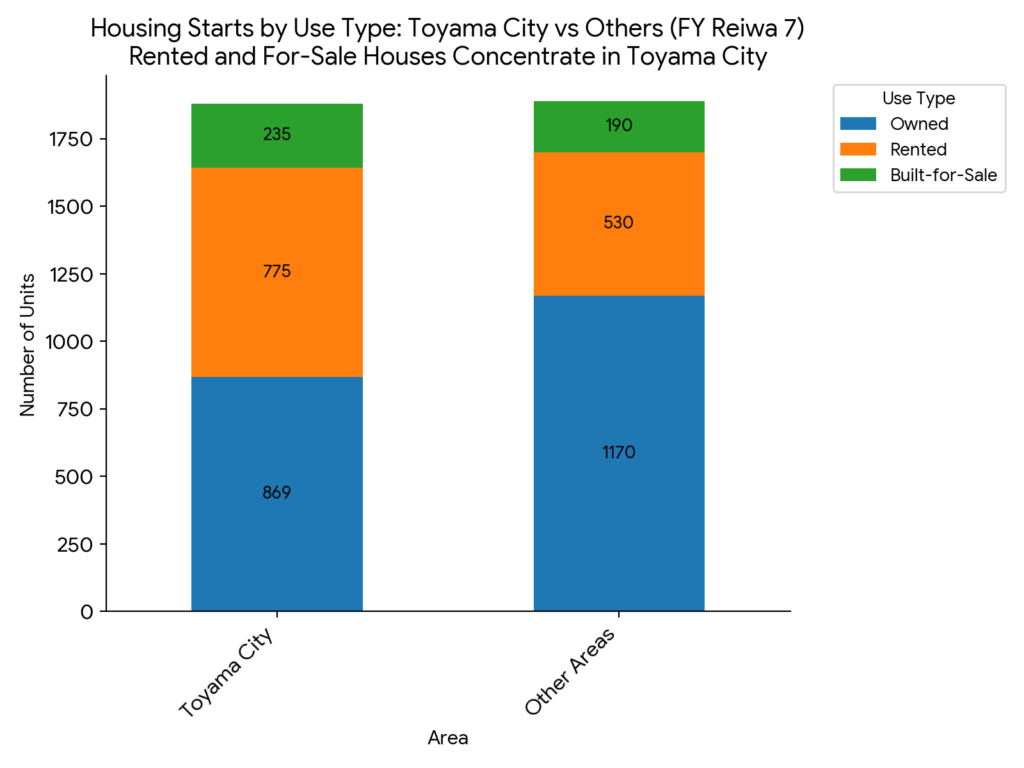
This shows the comparison of housing starts by use type between Toyama City and other areas. It visualizes that built-for-sale houses and rented houses are concentrated in Toyama City.)
The number of housing starts in Toyama City, the capital city, reached 1,893 units. This is exactly half of the whole prefecture. 869 owned houses, 775 rented houses, and 235 built-for-sale houses were started here. More than half of the built-for-sale houses and about 60 percent of rented houses supplied in the prefecture are concentrated in Toyama City.
Looking at the details of rented houses in Toyama City, there are 321 row houses and 448 apartments. Apartment building developments are still working here. For built-for-sale houses, there are 193 detached houses and 42 apartments. Toyama City was the only place in the prefecture that had built-for-sale apartment developments. Demand that can absorb the rising land prices and construction costs into final sales prices or rents is now limited to the center of Toyama City and highly convenient areas.
Differences in Business Viability in Takaoka, Tonami, and Uozu Cities
In other main cities in Toyama Prefecture, development methods are dividing by area.
In Takaoka City, the core city in the western part, 217 rented houses were supplied out of 605 total housing starts. Most of them are row houses with 147 units. Apartment units are limited to 69. 92 built-for-sale houses were developed, but none of them are apartments. Detached houses are the main focus.
In Tonami City, 68 rented houses were supplied out of 182 total starts. These include 22 row houses and 44 apartments. Small-scale apartment development continues in areas with commercial facilities and transportation networks.
In Uozu City, the core city in the eastern part, total housing starts shrank to 96 units. There was a supply of 18 rented houses, but all of them were detached houses or row houses. There were zero apartment starts. Built-for-sale houses were also limited to 8 units. In areas where the balance between buyer purchasing power and development costs is broken, high-risk apartment development stops.
Local Movements and Choices in Surrounding Areas
This shows the breakdown of rented housing by building type in main areas other than Toyama City. It visualizes the difference in the supply balance of row houses and apartments.
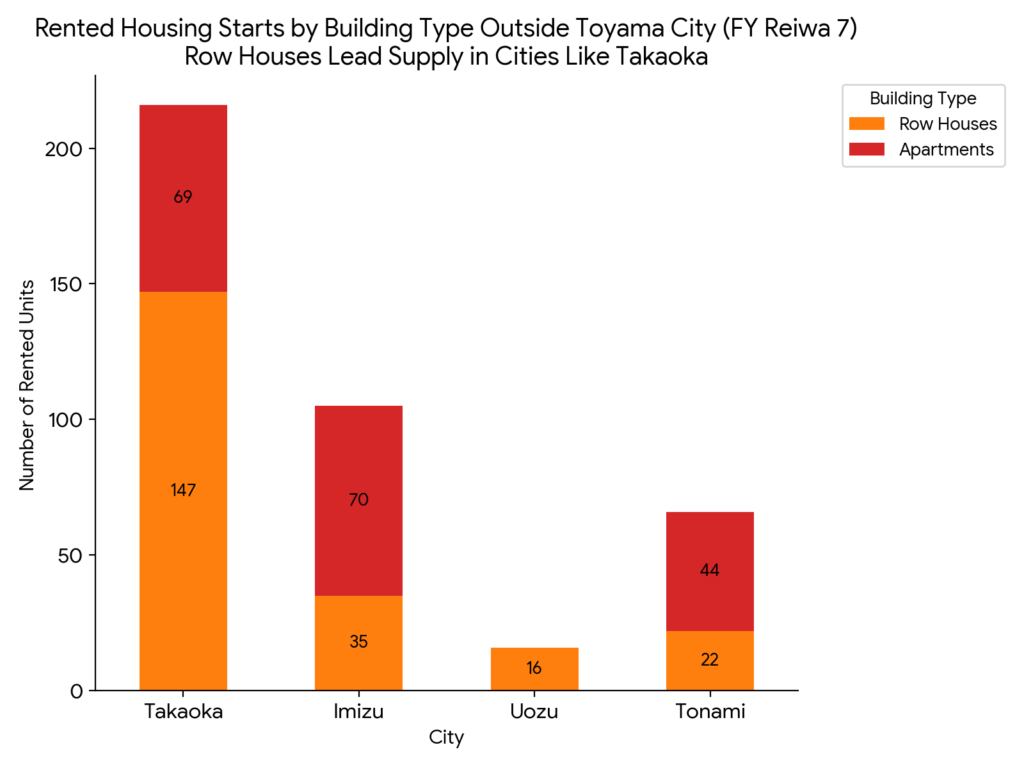
Even in surrounding areas outside the main cities, development matches the location conditions.
In Imizu City, next to Toyama City and Takaoka City, 106 rented houses were supplied out of 357 total starts. There are 35 row houses and 70 apartments. Apartment development is advancing to capture the rental demand as a commuting area for the two neighboring big cities.
In Tateyama Town, 17 rented houses and 6 built-for-sale houses were supplied out of 94 total starts. There is still room for small-scale rented row houses and built-for-sale detached housing businesses, not just owned detached houses.
In Himi City, 42 rented apartments were started out of 105 total starts. Local factors, such as rental demand for employees working at specific business facilities, pushed this development.
Choice of Location and Structure under High Cost Environment
The Toyama Prefecture housing market is shrinking overall, and developers are selecting strictly.
Because of rising material prices and labor costs, it became difficult to secure profit for non-wooden buildings like reinforced concrete structures. As a result, development methods are moving to wooden row houses and detached houses where costs are easier to control.
Areas where developers can raise rents or sales prices are limited to parts of Toyama City. In Takaoka City and Imizu City, low-risk rental development focusing on wooden apartments was chosen. In Uozu City, apartment development was skipped entirely. The condition to continue business is whether there is local demand that can absorb the increased construction costs, and the optimization of building plans focusing on wooden structures.