Summary
According to market data from December 2025, the Japanese office market appears to be recovering on the surface, with vacancy rates in Tokyo reaching low levels not seen since 2020. However, a detailed analysis reveals a harsh polarization forming underneath. While vacancy rates decrease, “potential” vacancy is rising, indicating that companies are not just expanding but actively relocating to better buildings. Furthermore, rising construction costs have created a “cost-push” market where rents rise even when vacancies increase in regional cities. Heading into 2026, the market will likely split decisively into “winners” (high-spec, modern buildings) and “losers” (aging, small-scale buildings), driven by a shortage of new supply in Tokyo and the inability of older properties to meet modern needs.
Key Points to Understand This Article:
- The gap between “lower vacancy” and “higher availability” suggests an acceleration of tenant relocation and strict selection, rather than simple market expansion.
- The market has shifted to a “cost-push” phase where rents rise regardless of the supply-demand balance, weeding out buildings and tenants that cannot adapt to inflation.
- The “Supply Cliff” in Tokyo in 2026, combined with the aging of small-scale buildings, will make the disparity in asset value definitive.
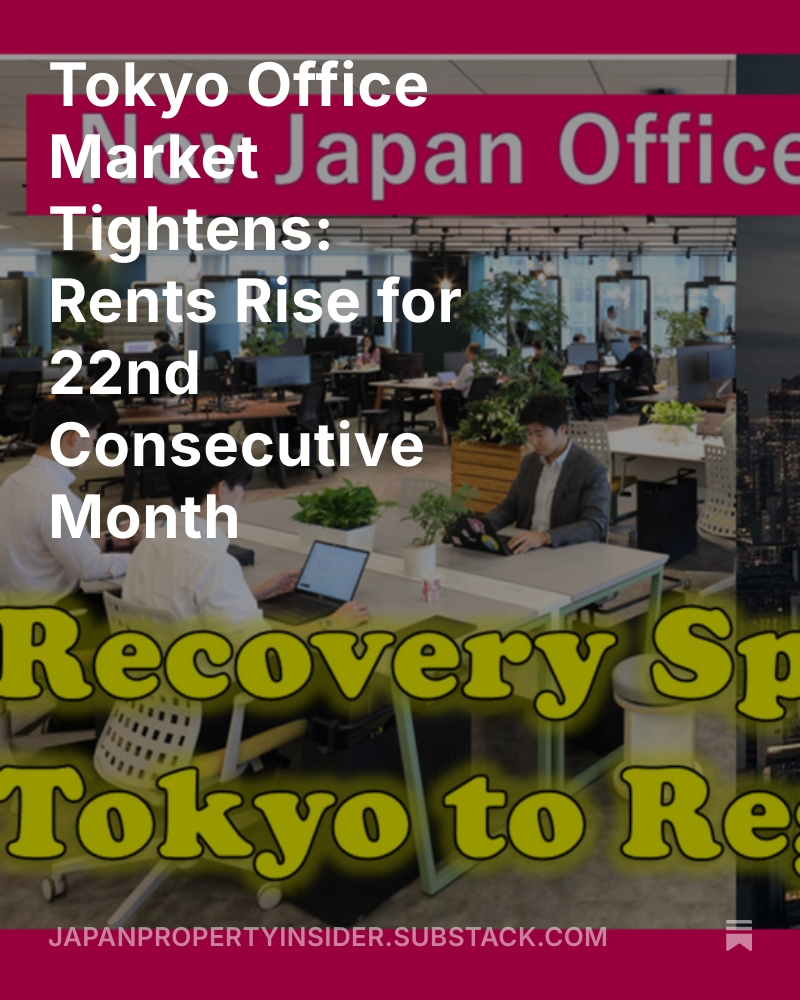
In January 2026, the Japanese real estate market seems lively. Real estate stocks are hitting record highs, and major data shows recovery. However, by integrating data from Xymax Research Institute, Mitsubishi Real Estate Services, Miki Shoji, and reports from the Nikkei, we can see a structural change that cannot be explained simply by the word “recovery.” This article explains the separation between winners and losers occurring behind the numbers.
Tenant Mobility Behind the “Low Vacancy” Rate
The data for December 2025 looks very strong at first glance. According to Miki Shoji, the vacancy rate in Tokyo’s central 5 wards has dropped to 2.22%, the lowest level since 2020. Mitsubishi Real Estate Services also reports that vacancy rates in some central areas have fallen below 1%. This has led to optimism in the stock market, pushing up share prices for major developers like Sumitomo Realty & Development and Mitsui Fudosan.
However, we must look at the “Potential Vacancy Rate” (availability rate). According to Mitsubishi Real Estate Services, while the confirmed vacancy rate is dropping, the potential vacancy rate—which includes spaces where tenants have given notice to leave—is actually rising (+0.07 points). This trend is especially strong in Chiyoda Ward and Shinjuku Ward.
What does this mean? It means that while spaces are being filled, cancellations are increasing at the same time. This indicates a game of “musical chairs.” Companies are not just filling floor space; they are actively moving to upgrade their locations and building specifications. As seen in the upward revision of earnings for TKP (a major conference room operator), there is a strong “return to office” demand, but it is a demand for high-quality communication spaces. Tenants are concentrating on competitive buildings and abandoning those that do not meet their standards.
The Arrival of “Cost-Push” Rent Inflation
In the traditional real estate cycle, rents go down when vacancies go up. However, the current Japanese market is breaking this rule.
In the Osaka Business District, the vacancy rate rose to 3.84%, and in Yokohama, it worsened to over 7%. Despite this, average rents in Osaka have risen for 10 consecutive months, and Yokohama is also seeing rent increases. This is a clear case of “cost-push inflation.”
Due to soaring construction costs, the rent for newly supplied buildings must be set high to ensure profitability. These new buildings act as an anchor, pulling up the overall market rent. As reported by the Nikkei, high-quality real estate assets can easily pass on these costs in an inflationary environment, which is a reason for the high stock prices of developers.
However, for tenants, this presents a harsh reality: “There is empty space, but it is not cheap.” Companies are being forced to choose between paying higher rents for high-spec offices or downgrading to cut costs. This rent inflation serves as a filter, removing players without financial strength from the prime market.
The 2026 Problem and the Aging Stock
The decisive factor for the market in 2026 will be the extreme imbalance of new supply.
In the Tokyo Business District, the volume of new office supply in 2026 will decrease significantly compared to the previous year—a “supply cliff.” With supply shrinking while demand for high-spec office remains solid, building owners will have strong bargaining power. Conversely, cities like Nagoya will face a wave of new supply, putting pressure on existing buildings.
A more serious issue is the “age” of the buildings. According to the “Office Pyramid 2026” report by Xymax Research Institute, the average age of small and medium-sized buildings (less than 5,000 tsubo) in Tokyo’s 23 wards has reached 36.0 years. In contrast, large-scale buildings are relatively younger at 26.4 years on average.
Modern companies require high ceilings, advanced air conditioning, and high environmental performance. Aging small buildings cannot meet these needs. Furthermore, due to high construction costs, rebuilding these small buildings is economically difficult. Therefore, despite the shortage of supply in Tokyo, demand and rent increases will concentrate only on large, high-spec buildings. Old, small buildings will be left behind, creating a structural vacancy problem.
Conclusion
The real estate market in 2026 will be a year where the distinction between assets becomes clear, contrary to the optimistic mood of “general recovery.”
- Winners: Large-scale, high-spec buildings in central Tokyo that can pass construction costs onto rents, and the major developers who own them.
- Losers: Old, small-scale buildings that cannot accommodate relocation needs, and tenants who cannot survive the rent inflation.
The market has shifted from a phase of “overall improvement” to a phase of “extreme concentration on quality assets.” Investors and businesses should not be misled by average numbers but must strictly assess the competitive power of individual assets.
Sources:
- Xymax Research Institute, “Office Pyramid 2026” (January 14, 2026)
- Mitsubishi Real Estate Services, “Tokyo Office Market Trends as of End of Dec 2025”
- Miki Shoji, “December 2025 Office Market Data”
- Nikkei, “Real Estate Stocks Rise Against Headwinds: Office Market Booming Despite Rate Hikes” (January 8, 2026)
- Nikkei, “TKP Stock Hits 5-Month High: Net Profit Forecast Revised Upward” (January 15, 2026)